
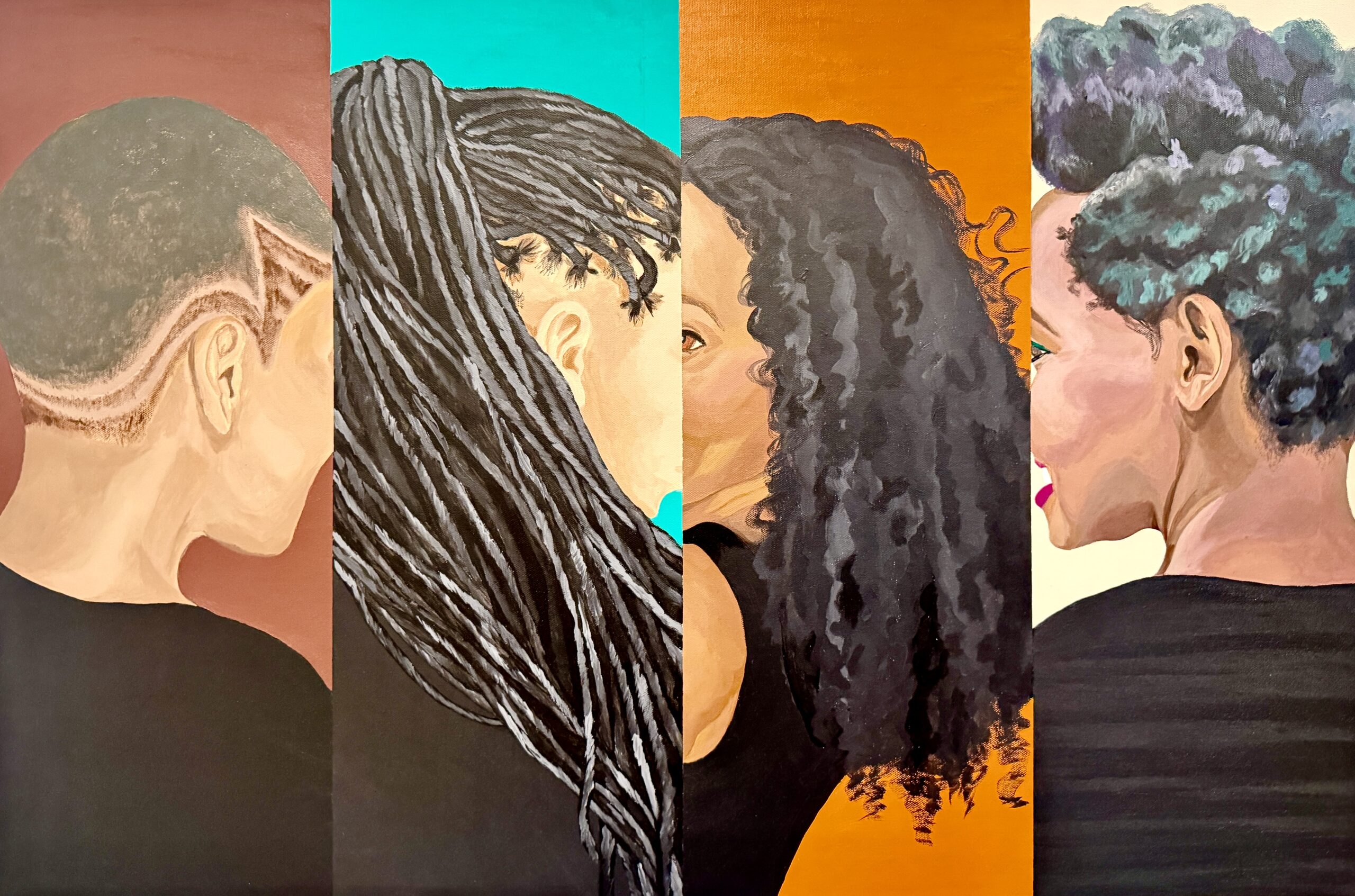
“As much as India.Arie said, ‘I Am Not My Hair,’ we are also our hair.”
That observation from curator Diamond Ashman serves as the foundation of Free Crowns, a group exhibition exploring the relationship between Black hair, identity, culture, and self-expression.
Inspired by the CROWN Act, legislation prohibiting discrimination based on natural hair textures and protective styles, the exhibition examines the lived experiences behind a law made necessary because Black hair has too often been judged before the person wearing it.
Yet Free Crowns is not an exhibition about discrimination alone.
“This exhibition is all about Black freedom, Black hair, Black culture, and embracing ourselves in every form,” Ashman said.
That idea unfolds across works that explore memory, growth, visibility, creativity, resistance, and joy.
For Ashman, the significance of Black hair remains deeply relevant.
“When people see our hair as African Americans, sometimes it can get misconstrued, or it can be judged off bat without knowing the story, or the reasoning, or the culture behind why we style our hair in certain ways.”
In a brilliant move, Ashman chose to display the artwork in Back to Nature Salon, a natural hair styling salon in the historic Third Ward.
Ashman’s own artwork, under her psydonym, D.GEMM, reinforces the exhibition’s themes.
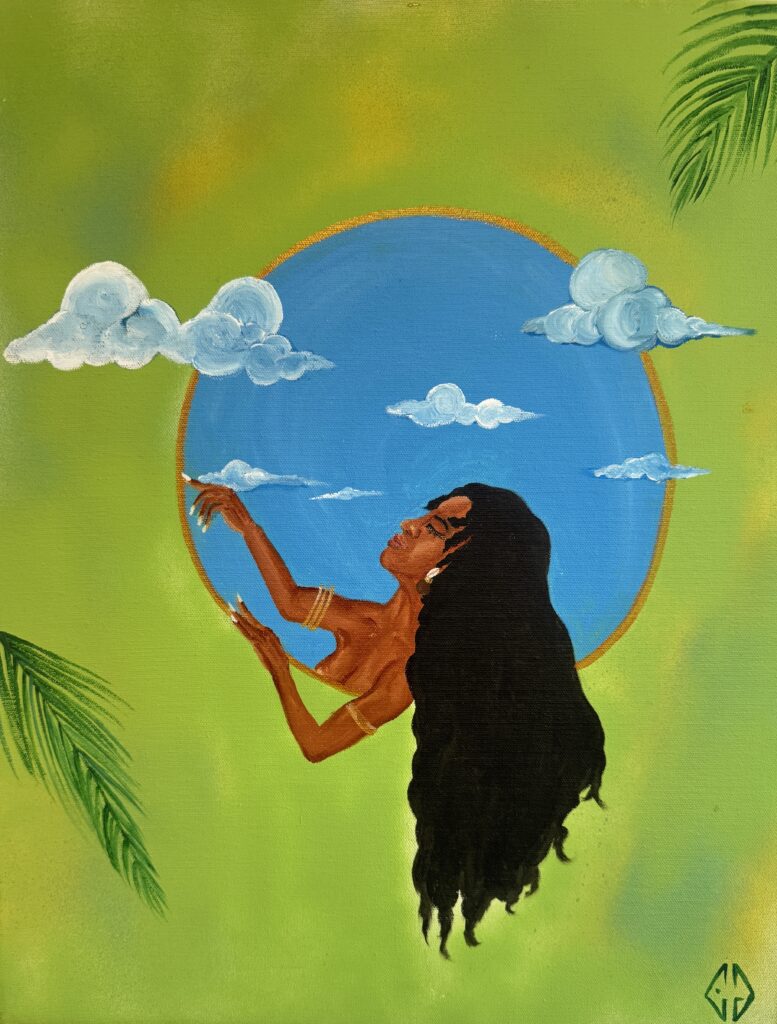
Flourishing Beauty celebrates growth and possibility through a figure reaching skyward, while Temple of a Goddess assembles a woman from vibrant geometric forms, reflecting Ashman’s belief that every experience contributes to who we become.
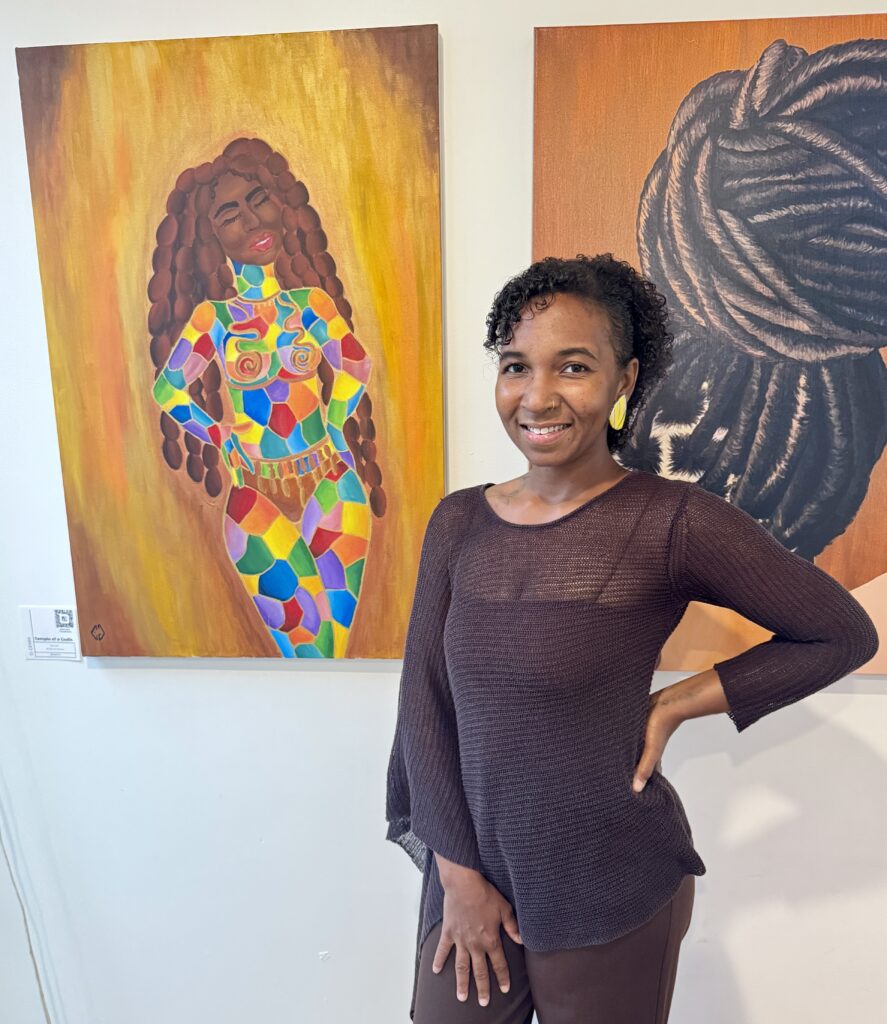
“No matter what style you’re wearing, no matter what you’ve been through, all of it is a masterpiece, which is you,” she said.
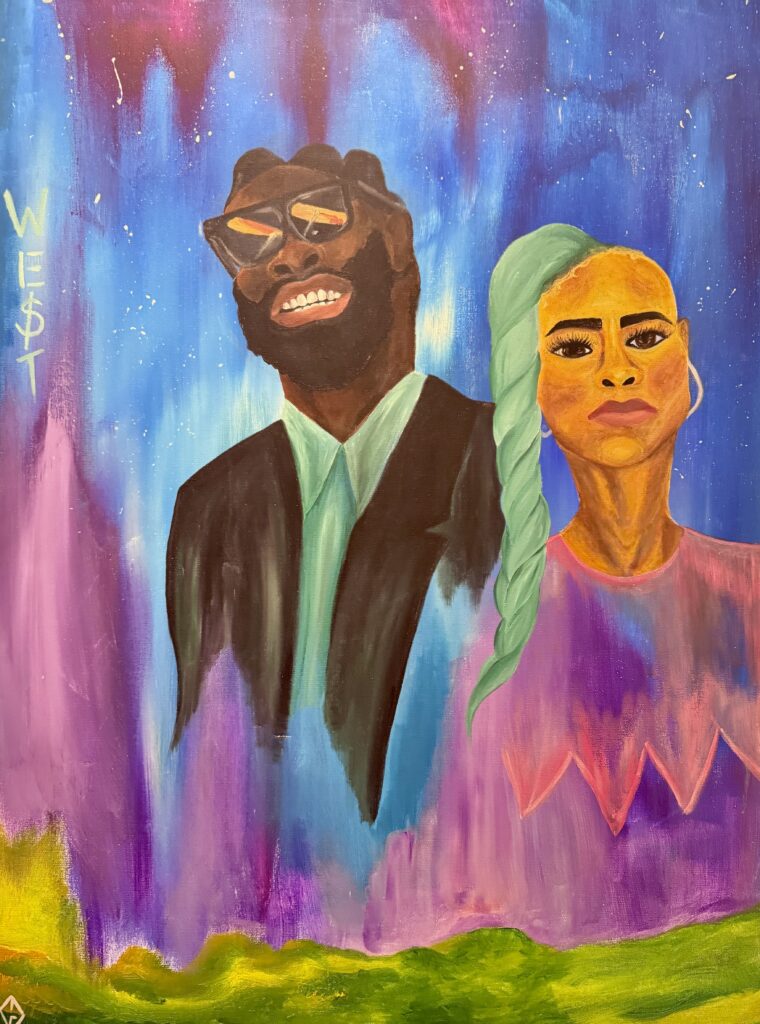
Her portrait of Houston creatives Tobe and Fat Nwigwe expands the conversation beyond hair itself, celebrating Black creativity, family, and cultural pride.
In addition to these themes, Amber Randall also addresses identity and memory.
“I always struggled with identity because I grew up in the suburbs, but I went to school in the hood,” Randall said.
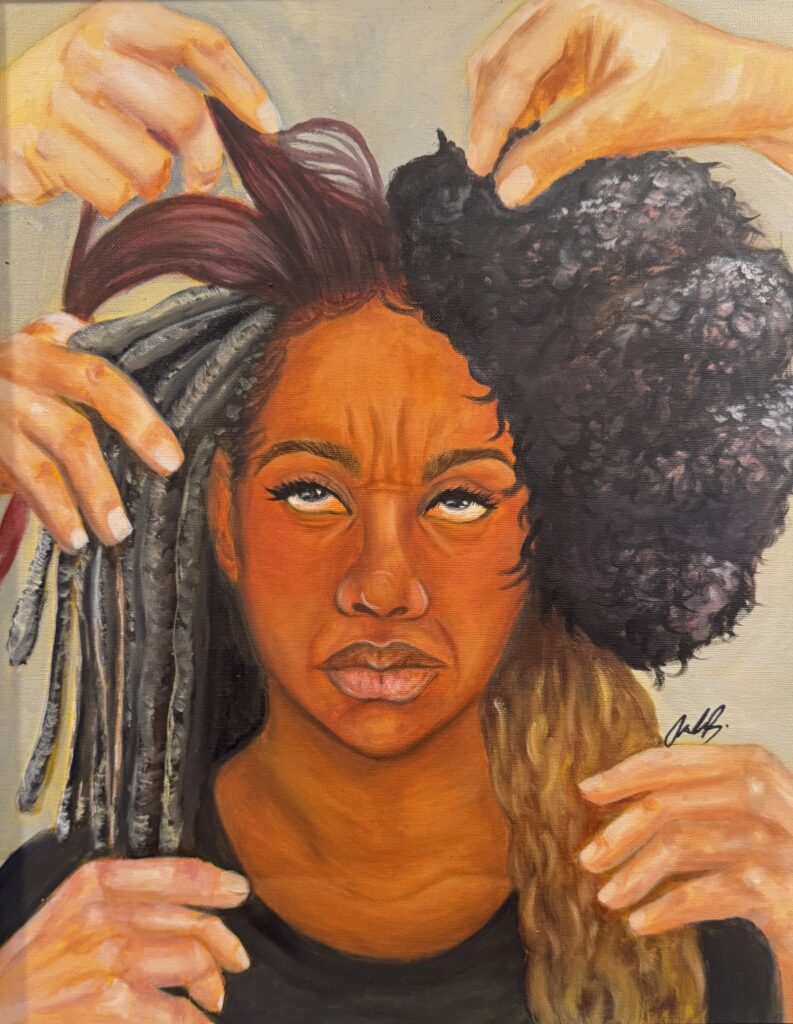
That experience drives Split Ends, one of the exhibition’s most powerful works. The central figure’s hair is pulled in multiple directions by the hands of unseen people. Randall explained that the hands represent workplace microaggressions and the pressure of determining “what type of hair would be appropriate in what setting” and “what type of accent would be appropriate in what setting.”
In her painting Sunday Morning, Randall depicts a mother gently brushing her daughter’s hair while surrounded by flowers beneath a bright sky.
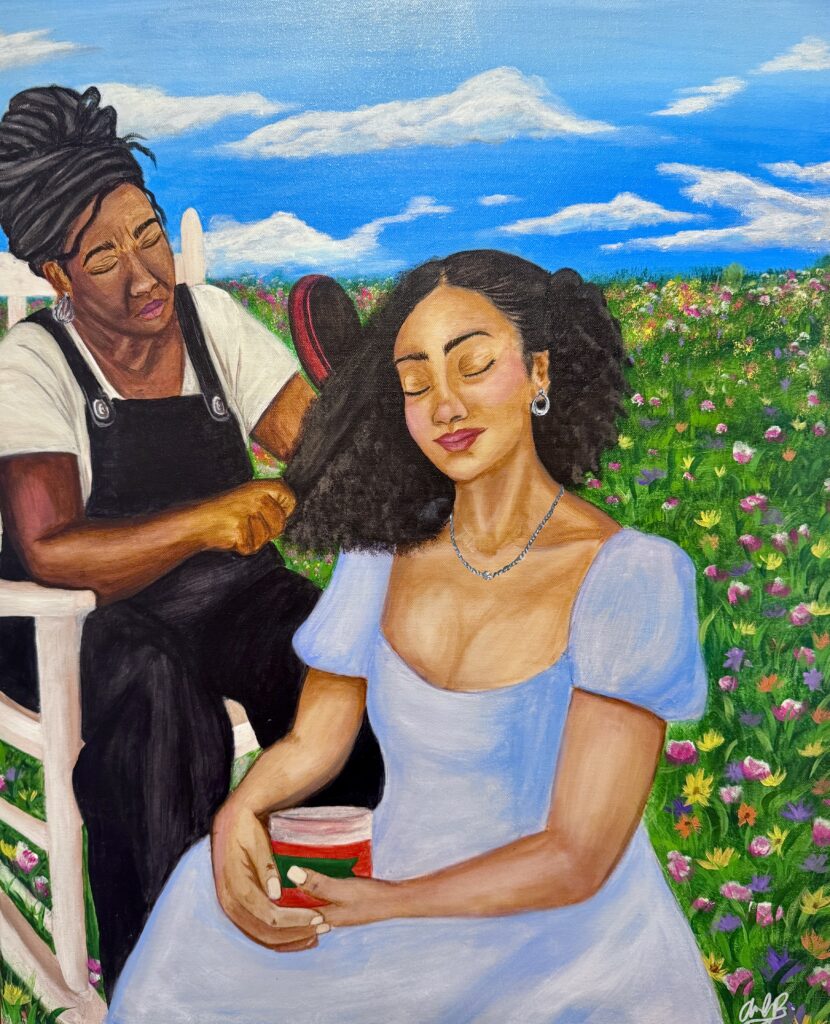
“Growing up, we did not do hair in a field of flowers,” Randall said with a laugh. “But when I look back on my childhood, it’s kind of what Sunday mornings feel like to me.”
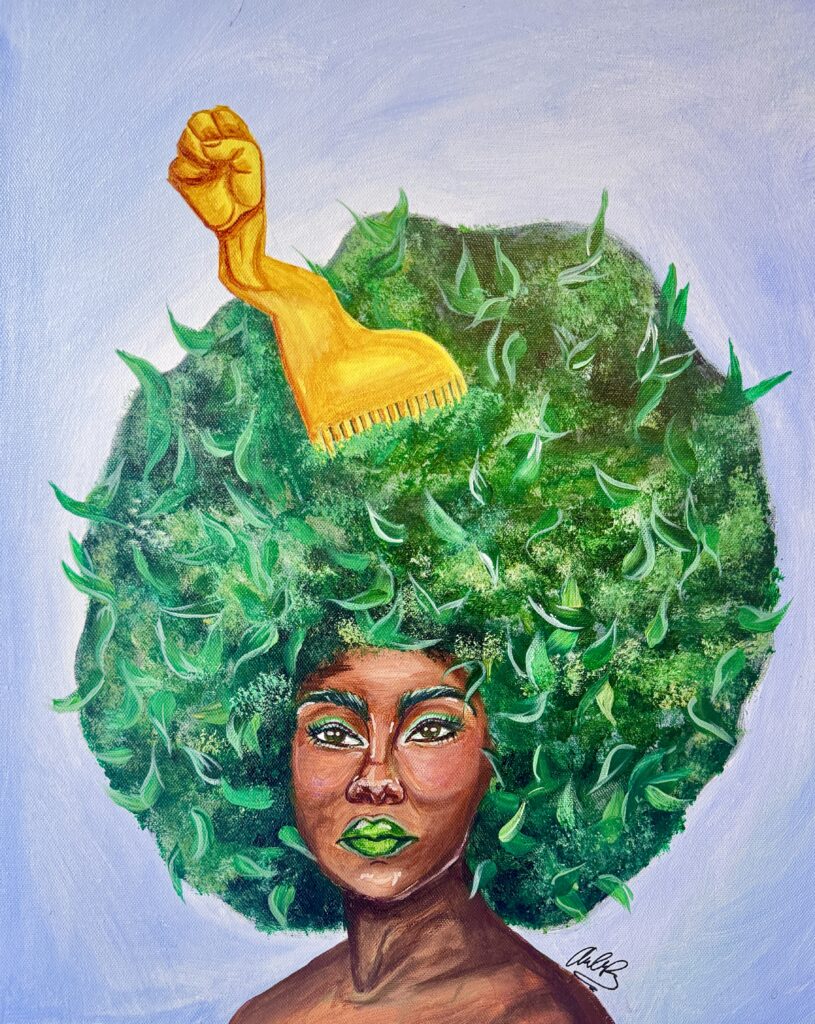
In Resistance, Randall transforms an Afro pick into a raised fist, merging a familiar hair care tool with a powerful symbol of Black pride and self-determination.
The subject’s lush, leaf-filled Afro evokes growth, resilience, and a connection to nature, while her steady gaze conveys confidence rather than confrontation.
Randall suggests that embracing natural hair can be an act of resistance, but also an expression of beauty, freedom, and self-acceptance.
Briana LeAndre (aka BML) continues the conversation with her three paintings – Love Thy Crown, New Growth, and Loc’d In.
“You should love your hairstyle, your hair, your crown, no matter what style it’s in,” LeAndre said.
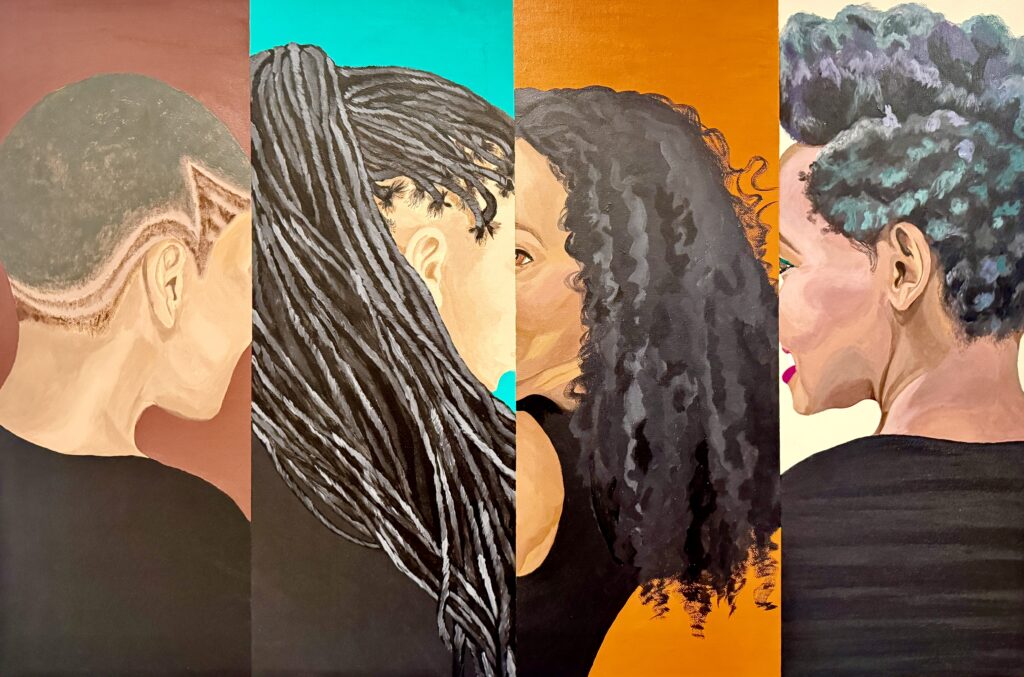
That philosophy drives Love Thy Crown, a portrait celebrating multiple Black hairstyles and the individuality they represent.
In New Growth, flowers emerge from braids arranged in a protective style.
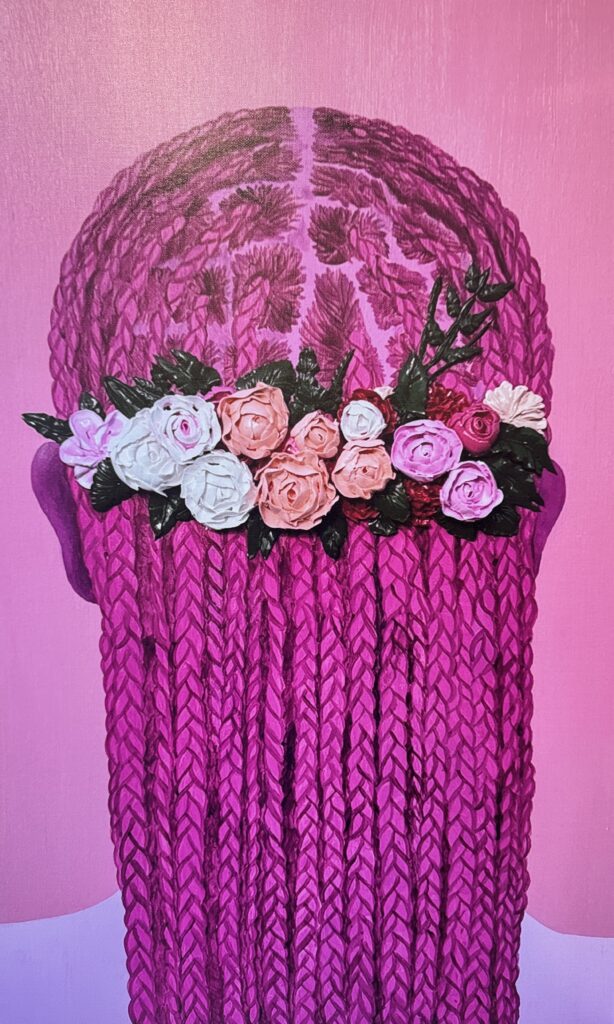
“When your hair is in a protective state, it’s away from the outside elements, which allows it to grow,” LeAndre explained, connecting the process to a period when she was balancing motherhood, engineering, and a growing creative practice. “It was a new growth period for me.”
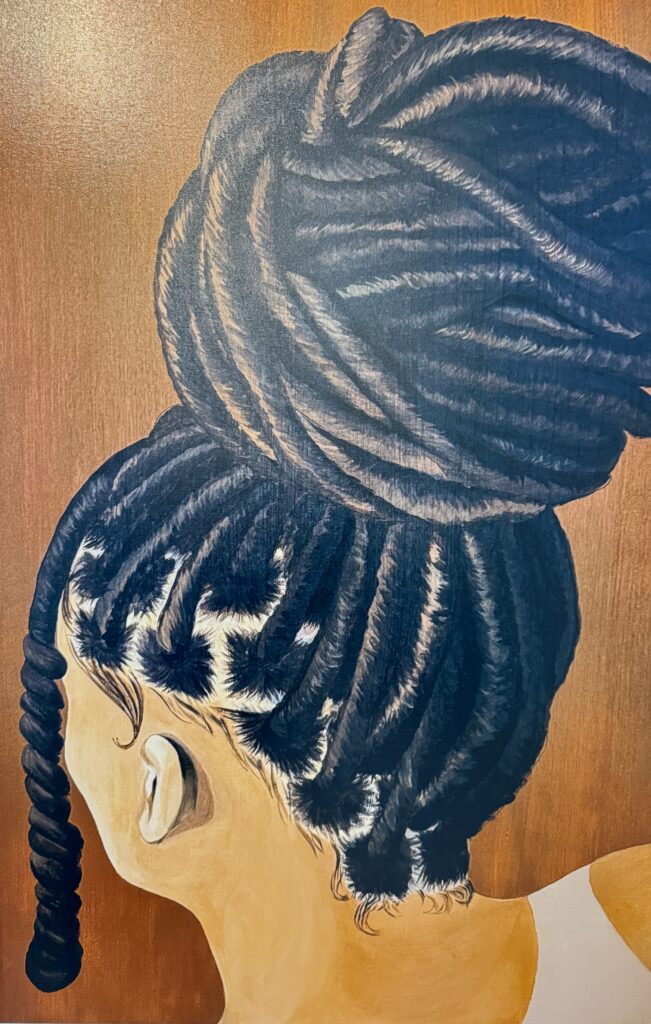
That journey culminates in Loc’d In, which LeAndre described as her decision to become fully committed to her art. Together, the works trace a progression from acceptance to growth to purpose.
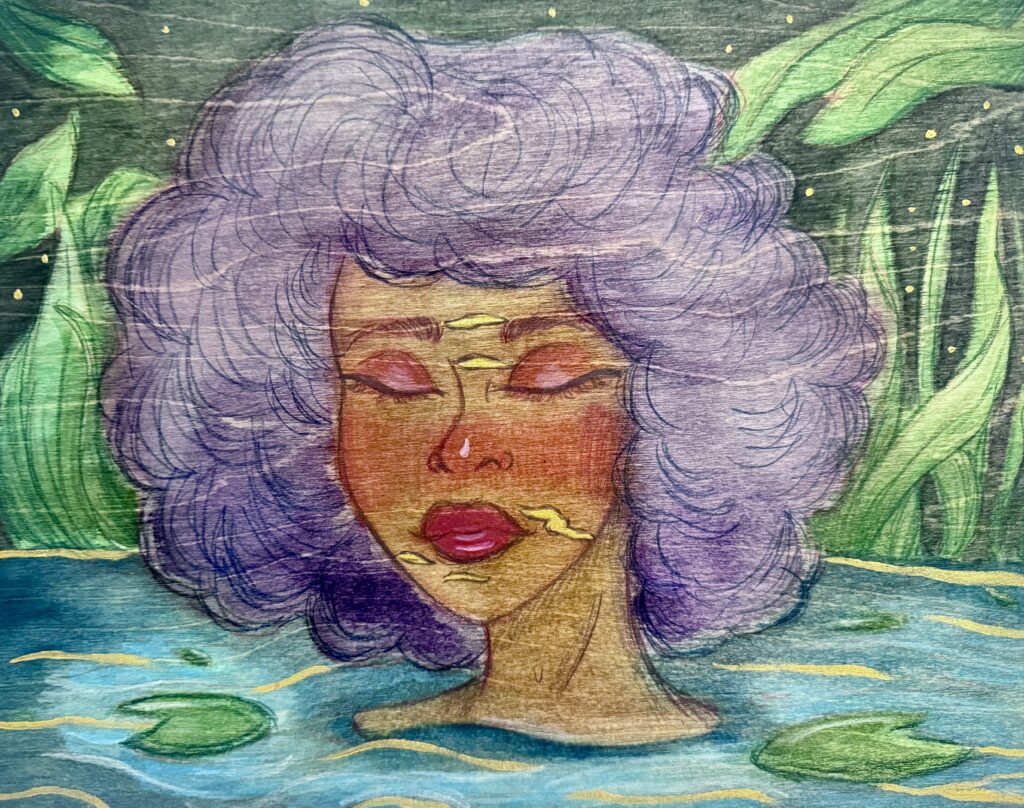
In Pond Meditation, Alese the Artist presents as a natural extension of inner peace. The figure’s lavender curls bloom like a cloud above still water, creating a dreamlike space where beauty, self-reflection, and nature exist in harmony.
Dwayne Moore’s Metamorphosis introduces a distinctly contemporary voice into Free Crowns.
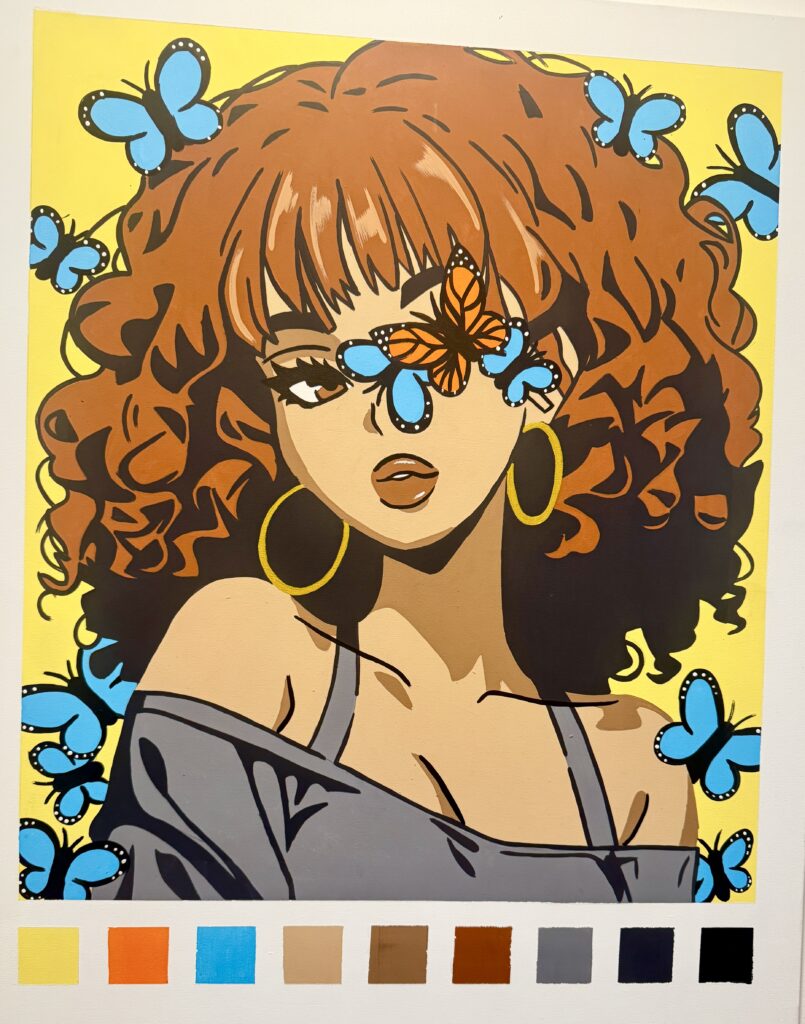
Drawing from anime aesthetics, Moore (aka Black Crown Paintings) depicts a young woman surrounded by butterflies against a vibrant yellow background. The work immediately captures attention through its bold colors, graphic lines, and playful energy. Yet beneath its pop-inspired surface lies a thoughtful meditation on transformation.
Moore explained that butterflies serve as a metaphor for the evolution of Black hair and personal growth. The monarch butterfly positioned across the subject’s eye symbolizes beauty and change, while the surrounding butterflies reinforce the theme of ongoing transformation. Moore’s anime-inspired approach expands the exhibition’s visual vocabulary, demonstrating that conversations about Black identity and self-expression can be explored through contemporary popular culture as effectively as through traditional portraiture.
Dita Montana approaches the exhibition through symbolism and mixed media.
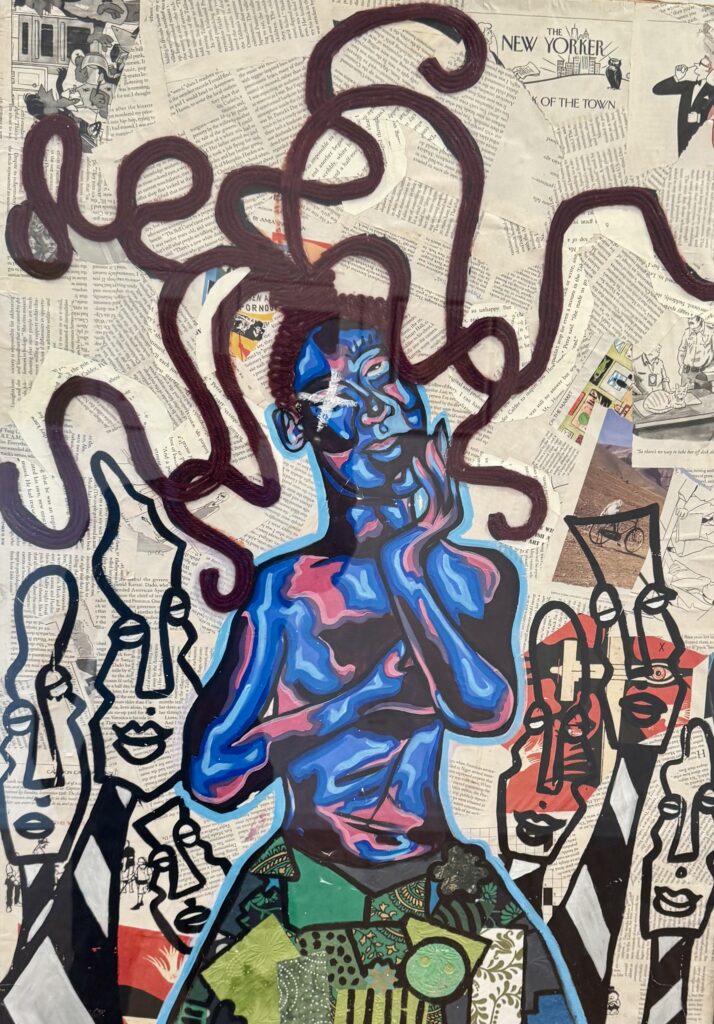
Her striking Medusa replaces the snakes of Greek mythology with strands of yarn.
“I’m representing natural hair,” Montana explained. “I use yarn for Medusa’s hair, and that represents the natural state in which hair exists.”
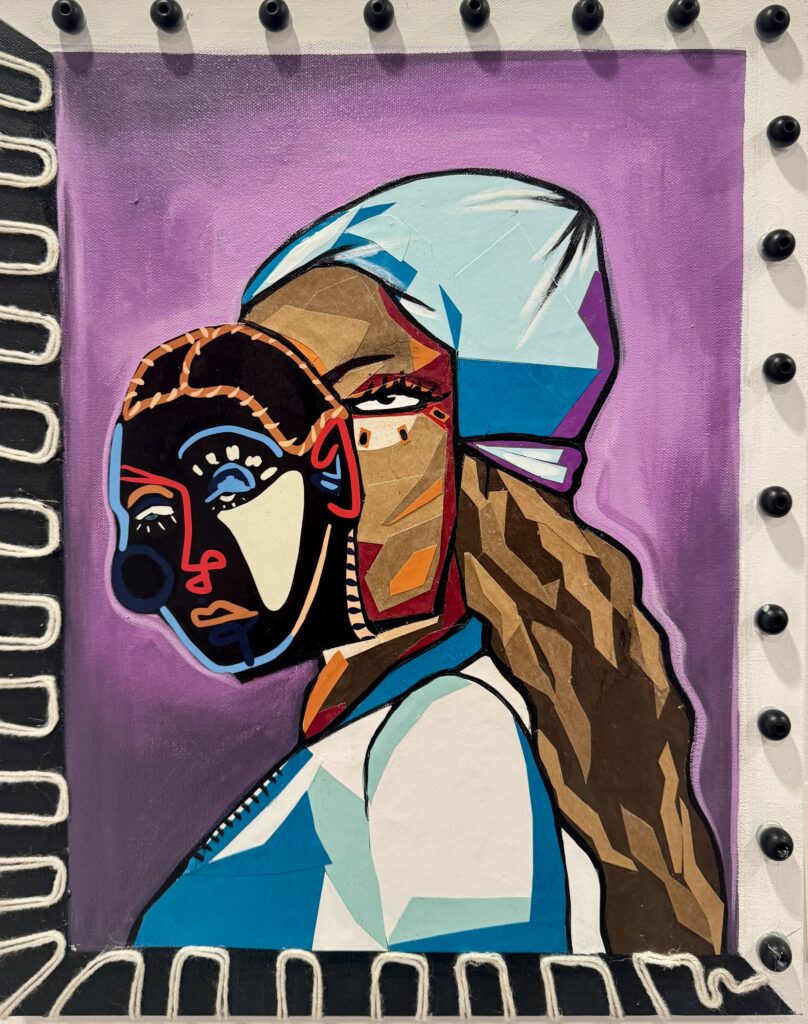
A figure traditionally associated with fear becomes a symbol of beauty and power. Her companion works, Who Are You? and All Eyes on Me, continue her exploration of identity and perception through masks, collage, and fragmented imagery.
What makes Free Crowns so successful is its refusal to reduce Black hair to a single narrative. The exhibition acknowledges the discrimination and microaggressions that inspired the CROWN Act, but it insists on something equally important: Black hair is also a source of memory, beauty, imagination, and joy.
“Hair is significant in 2026 because it represents us,” Montana said. “Our crown, our politics, ourselves. It represents us as a whole and our community.”
Frederick J. Goodall is the Editor-in-Chief of Mocha Man Style, media spokesperson, event host, photographer, and a top social media influencer in Houston, TX. He likes to write about fashion, cars, travel, and health.