

All my life, I’ve been drawn to learning about different spiritual practices. I had never heard of Harawi before this performance, but Julia Bullock and Conor Hanick led me through an immersive experience at the Cullen Theater at the Wortham Center that I will never forget.
Harawi is an ancient Andean tradition of music and poetry rooted in Quechuan cultures of Peru, Ecuador, and Bolivia.
Traditionally performed a cappella by older women in a high vocal register, Harawi expresses love, loss, and grief. The practice treats the body as a living archive, valuing complex rhythms, repetition, improvisation, and the interplay between movement and sound. A singer often cries out “ay yah” or “yaooh,” then lets the melody slide downward in a long glissando, a defining gesture of the form.
In Andean villages, a man may still express love by playing a known harawi on the flute near a woman’s home, allowing sound to speak where words cannot.
French composer Olivier Messiaen encountered Harawi through a 1925 ethnographic anthology, yet it offered him a way to process his own experiences of love and loss.
He composed his song cycle Harawi in 1945 after returning from a World War II prisoner-of-war camp. At the same time, his wife Claire Delbos was suffering severe mental deterioration, including total amnesia, while a new romantic relationship with Yvonne Loriod was beginning.
The resulting 12-song cycle explores life and death, pain and joy, spirituality and sensuality through surreal French texts Messiaen wrote himself. He also incorporated real and invented Quechua words for their sound rather than their literal meaning.
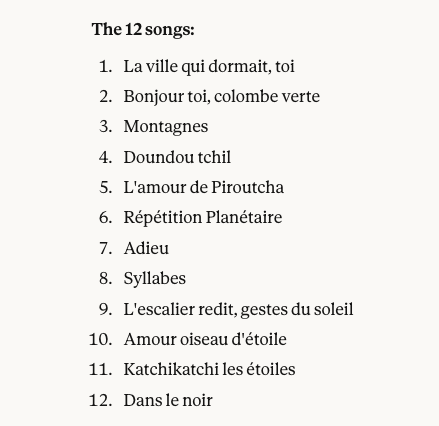
The work runs about 50 minutes and is filled with vivid imagery, including birds, stone statues, ritual dances, and moments of intimate tenderness. Harawi is the first part of Messiaen’s Tristan trilogy, linking Andean love songs to the Celtic myth of Tristan and Isolde. Both traditions center on love that faces insurmountable obstacles and ultimately ends in death.
Julia Bullock has made this work deeply personal.
A founding member of the American Modern Opera Company, she has spent years exploring Harawi while openly grappling with Messiaen’s appropriative use of Andean traditions.
She consulted contemporary Harawi practitioners, including dancer and choreographer Luz Zenaida Hualpa García and visual artist Karen Michelsen Castañón, to inform her interpretation.
As Bullock has written, Harawi is cosmic in scale, complicated in subject matter, chaotic at times, and ultimately about seeking connection.
Bullock has a remarkable voice that touches your soul and the technical skill required to perform this demanding piece. The score requires extreme agility, sustained high notes, birdlike trills, and moments of near-whispered intimacy. She handled these demands with precision and emotional clarity, but what struck me most was how she physically inhabited each song. I could see the tension in her shoulders during the more anguished passages, the softening of her face during moments of tenderness. The audience was completely transfixed.
One song that stood out was “Répétition Planétaire,” where Bullock’s voice seemed to echo across vast distances, evoking both cosmic loneliness and the cycles of planets. It was haunting and beautiful. Across the entire cycle, from “La ville qui dormait, toi” through pieces like “Doundou tchil” and “Syllabes,” which rely on invented syllables, to the closing “Dans le noir,” she committed fully to each emotion.
Conor Hanick matched Bullock’s intensity with playing that was both technically exacting and deeply expressive. As a founding member of AMOC and a pianist known for premiering new works, he used the piano as a narrative voice. I watched his hands move across the keys with remarkable precision. Sometimes the piano supported the singer, sometimes it pushed against her, but it was always in conversation. His playing illuminated Messiaen’s borrowings from Andean folk music while clearly tracing the recurring Tristan theme. The partnership between them felt lived-in, like they had traveled through this emotional landscape together many times before.
My one reservation involved the subtitles projected above the stage. For a work so invested in the body as a living archive, I found myself reading instead of fully surrendering to the sound and movement happening right in front of me.
By the end, the performance felt like a shared spiritual journey. We were invited into Messiaen’s grief, the ancient traditions that inspired him, and Bullock’s own meditation on devotion and loss. The questions Messiaen posed in his grief became questions for all of us: How do you stay connected to someone you love when memories begin to fade? How do you move forward while honoring what was lost? I left the theater reminded that music can still create space for the kind of deep emotional and spiritual work we all need to do.
After nearly an hour of this intense emotional journey, Bullock and Hanick returned for an encore of “Nobody’s Heart Belongs to Me” from the 1942 musical By Jupiter. It was a sweet, sentimental song that felt worlds away from what we had just experienced. After confronting the cosmic and the chaotic, the encore taught us that even after exploring profound grief and longing, we can still circle back to simple human truths about love and belonging.

Frederick J. Goodall is the Editor-in-Chief of Mocha Man Style, media spokesperson, event host, photographer, and a top social media influencer in Houston, TX. He likes to write about fashion, cars, travel, and health.