

I have loved jazz music for most of my life. It was the first music that taught me how to listen patiently and hear meaning between the notes.
Brandon Woody understands this, and jazz’s future is in good hands because of it.
The Baltimore-born trumpeter signed with Blue Note Records in November 2024 and released his debut album For The Love Of It All in May 2025. The New York Times and Los Angeles Times have both identified him as a rising force in contemporary jazz. He is a Bach-endorsed artist with growing international recognition. But none of that tells you what it feels like to hear him play in a room.
Woody makes you listen, and your spirit is rewarded with music that soothes, uplifts, and transforms. He is young, but he carries himself with the quiet authority of artists who came before him, when the music was protest and prayer wrapped in blue notes.
Da Camera brought Woody to Houston as part of its jazz series. The organization has spent decades programming artists who value craft and musical excellence. Woody fit that mission naturally.
The El Dorado Ballroom provided the right context for his show. During segregation, it was one of Houston’s few venues where Black performers and audiences could gather. Duke Ellington played that stage. So did Ella Fitzgerald and Ray Charles. That history quietly informs everything that happens there.
The room was intimate, with round tables close to the stage.
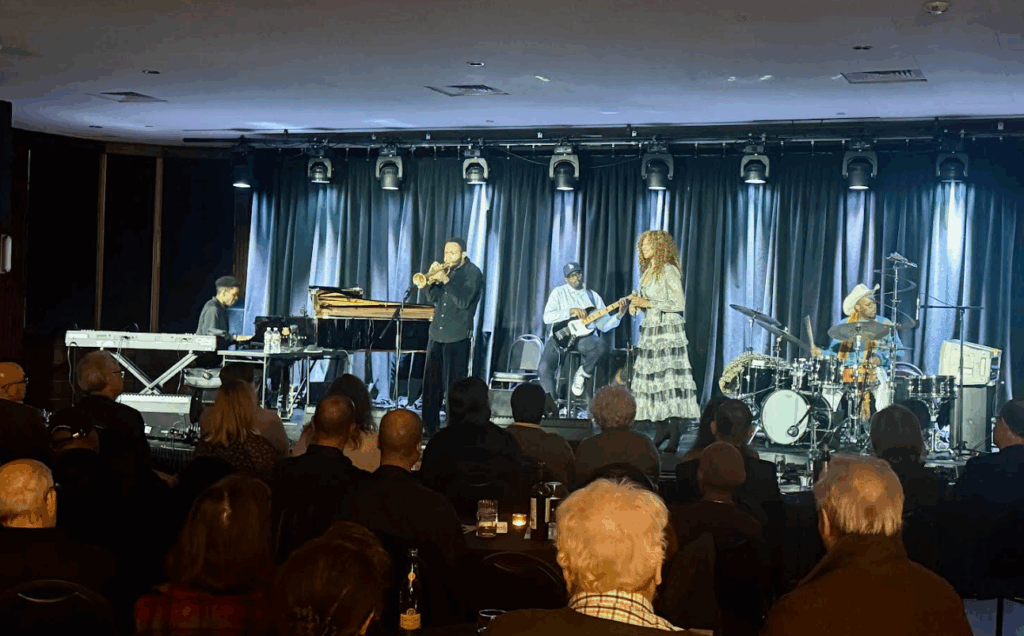
The set opened with “Perseverance,” a slow-building meditation that Woody framed as a spiritual breakthrough when hope feels distant. You could hear that struggle inside the phrasing. His trumpet tone was burnished and unhurried, each phrase shaped with intention rather than flash. Pianist Troy Long responded with voicings that suggested McCoy Tyner’s harmonic density. Michael Saunders anchored the bottom end with resonant, blues-inflected bass lines, while drummer Quincy Phillips worked in brushes and mallets, favoring texture over volume.
People listened with their whole bodies, and a collective energy filled the room as heads nodded and feet tapped softly.
Vocalist Imani-Grace Cooper joined for “We’re Not Scared,” and the interplay between her voice and Woody’s horn became the evening’s most compelling moment. Woody’s trumpet moved in and around her voice like a conversation, sometimes echoing her phrasing, sometimes answering it. It felt less like accompaniment and more like a duet, two voices trusting each other enough to leave room for silence.
The band loosened up on “Girl You Know It’s True” and “Winter Joint,” both drawn from Woody’s Blue Note debut. The latter prompted a laugh from Woody about Houston’s unseasonable warmth, a brief break in the set’s otherwise meditative arc. Phillips shifted to sticks, pushing the groove forward with crisp ride cymbal work. Saunders locked in underneath, walking lines that gave Long room to stretch harmonically.
Woody closed with “Real Love Part I” and invited the audience to participate. Cooper sang the melody once through, then turned to us and asked us to sing it back. And we did, not always on key, but in unison and in solidarity, for the love of the music. Woody’s horn wove through our voices like thread through fabric, stitching us together, making us whole.
This is what keeps me coming back to jazz. It is the moment when the distance between performer and listener dissolves, and the music creates community.
Woody is a young artist who respects tradition without being constrained by it. His band proved that jazz still knows how to do what it has always done best. It makes you listen and reminds you that some forms of communication go deeper than words.
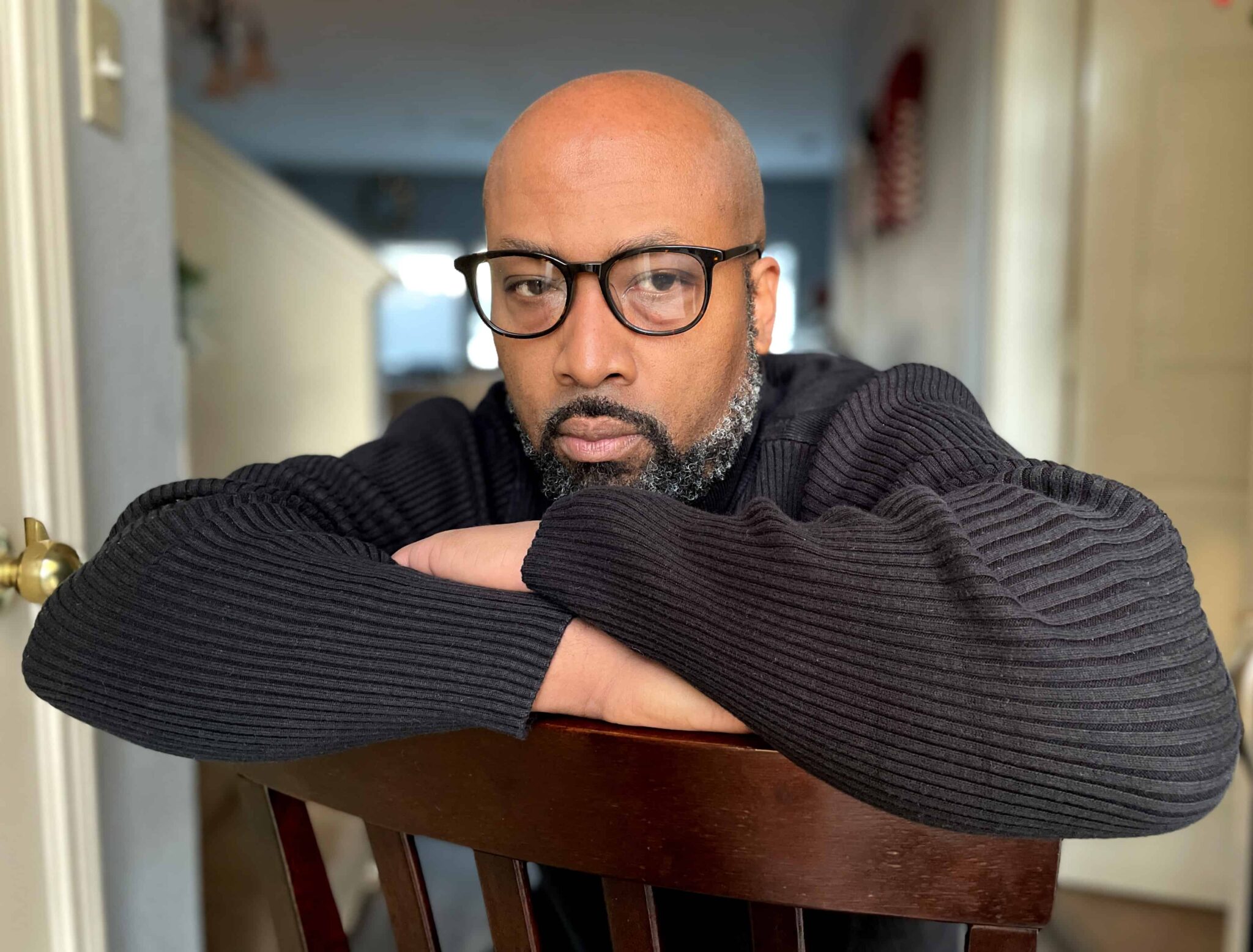
Frederick J. Goodall is the Editor-in-Chief of Mocha Man Style, media spokesperson, event host, photographer, and a top social media influencer in Houston, TX. He likes to write about fashion, cars, travel, and health.